<

Know Him and the Power of the Resurrection!
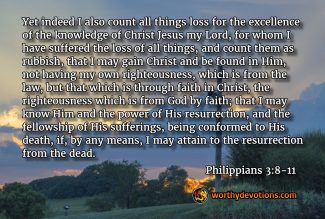
In today’s world of Smart Phones, tablets and instant Internet access, there are many things that we can “know.” “How long is the Golden Gate Bridge?” Pop out your iPhone, ask “Siri”, the golden-voiced digital encyclopedic genius, and you’ll have the factual answer in seconds.

Click here to finish this devotional journey.

What are your expectations?

The Jewish leaders of His time rejected Yeshua (Jesus) when He first came. He didn’t meet their expectations. They were expecting a Messiah who would bring relief from the Romans, restore the Kingdom of David, and usher in an era of tranquility throughout the world. It is probable that their intense jealousy of Yeshua blinded them to the numerous passages in the Tenach (OT) which describe Messiah as a suffering servant, since they were certainly aware of those passages.

Read more – let the Word sink in deeper.

Love at all times!

When Abraham is told by YHVH to offer up his son, Issac, the word “love” is spoken for the first time in the Bible. The Hebrew word for love is “ahavah”. This first mention of “ahavah”, which is the very nature of God [1 John 4:8] occurs in direct connection with sacrifice, the sacrifice of a most precious and beloved son. Abraham could not have known at that time that his obedient offering would foreshadow and typify the love of our Heavenly Father who offered up Yeshua, His only begotten Son 2000 years ago.

Click here to keep walking through this Word-filled moment.

Be in Total Peace!

The Hebrew word “shalom” has meaning that is deep and rich. Peace, completeness, prosperity, safety, contentment, health, blessing, and rest are all apportioned to the meaning of this remarkable word.. The ancient Hebrew spelling of “shalom” is interesting because it speaks only indirectly about these multiple meanings, but reveals something very profound about apprehending “shalom”.

Click here to finish this devotional journey.

Do You Have The Sign?

Yesterday, we began identifying the ancient Hebrew alphabet and exploring the potential symbolic meanings of its letters. The last letter, “Tav”, as we saw, strongly resembles a cross. Today, we’re going to look at how “Tav” is spelled in ancient Hebrew. The phonetic spelling of “Tav” is Tav (T)-Vav (V). Now the ancient letter, “Vav” strongly resembled a commonly used tent peg, and then, later, a common nail. So the spelling of “Tav” contains a cross and a nail.

Click here to read more of this devotional – let it speak to your heart.